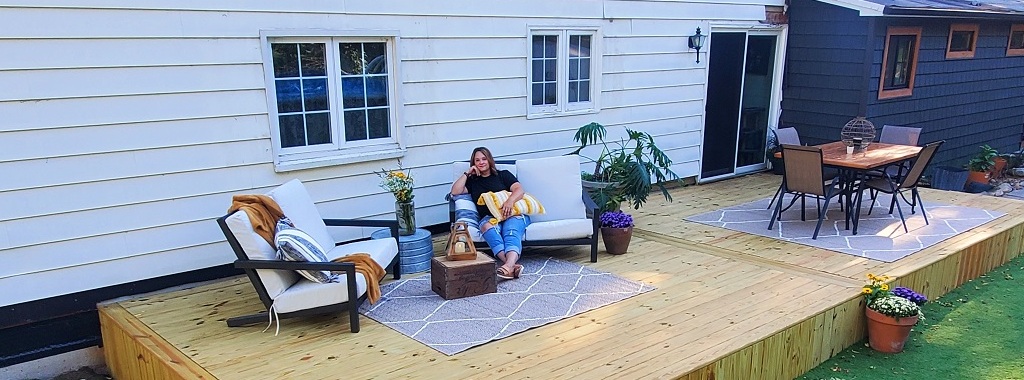


If you’re looking for a showstopping wood creation that you can also use for serving guests, look no further. This rustic bar is a fantastic entertainment hub for any backyard . With its wide counters and built-in shelves, you can stay fully stocked for any occasion.
For today’s project, we teamed up with Jamison Rantz from the Rogue Engineer to create a DIY coffee table that’s easy to build, and is built of new materials while having the look and feel of something built with reclaimed or pallet wood.
When you live in earthquake country, you know it’s not “if” there will be a big quake, it’s “when.” You may have an earthquake emergency kit ready, but there are also steps you can take now to strengthen your home to make it more resistant to earthquake damage. And if you live in California, there’s a program called the Earthquake Brace + Bolt (EBB) that provides up to $3,000 for seismic retrofit grants to homeowners residing in more than 150 California zip codes. If you’ve checked it before and your zip code wasn’t listed, be sure to check it again
Community resilience is the concept that we can design and build better to reduce susceptibility to disasters. The idea of building for resilience is in the DNA of Simpson Strong-Tie and is why we’re considered a leader in structural systems research, testing and innovation. That commitment to building for resilience is why we partner with other leaders in the field like the Dr. Lucy Jones Center for Science and Society.
Each year, Simpson Strong-Tie teams up with the West Coast’s top earthquake scientists and preparedness experts to take questions from Redditors about earthquakes and tsunamis. The Reddit AMA is part of the Great ShakeOut, the world’s largest earthquake drill, where 55 million people drop, cover and hold on. The next Great ShakeOut is scheduled to take place at 10:17 a.m. on October 17, 2019, and your organization still has time to get involved.
“Company culture” has become a catch-all term to express the essence of what makes an organization good (or, in some cases, not so good) to work for. As a human resources leader, it’s my honor to work with teams dedicated to acting as positive influencers in the culture of our company. When we set out to create new processes to protect and grow the unique culture of Simpson Strong-Tie, we had outstanding direction from our founder, whose values are as relevant today as they were more than 60 years ago when he first opened the doors.
Simpson Strong-Tie is proud to sponsor Building Safety Month. This annual event, which takes place over the entire month of May, is intended to raise awareness of building safety and all that it involves. The International Code Council pairs together professionals from the building construction, design and safety communities with corporations, government agencies, professional associations and nonprofits to promote building safety.
Legions of catatonic organisms lie asleep in the matrix, waiting only for momentary exposure to water and oxygen in order to awaken — whereupon the organisms immediately germinate, grow and fulfill their destiny, sealing the cracks in the fabric of their universe before falling dormant once again.
Thank you for stopping by! We’re taking a brief break today so Simpson Strong-Tie team members can celebrate the Fourth of July with family and friends.
Situated on the northwest coast of Oregon, the resort town of Seaside — population 6,685 — seems an unlikely place for advanced seismic and tsunami simulations. But just offshore Seaside’s charming 1920s boardwalk and its broad, sandy beaches famed for razor clamming, the Juan de Fuca tectonic plate is slowly sliding underneath the behemoth North American plate.
As we’ve seen with the hurricane seasons of that past decade or so, homes are not always built to withstand a major storm. The hurricane season of 2017 was one of the deadliest and costliest seasons in US history. Countless homes and buildings were severely damaged or destroyed, leaving thousands of families displaced. It will take years for communities to rebuild and recover from such devastation. Fortunately, there are solutions that can help protect your home from a hurricane or high-wind event.
Eighty-one years ago this May, traffic opened on a newly constructed bridge span between Marin County, California, and the city of San Francisco. At 4,200 feet long and with towers 746 feet high, the steel suspension bridge was the longest and tallest bridge of its time. Built at a cost of $35 million, held together with 1.2 million rivets, and painted international orange from end to end, the Golden Gate Bridge was an instant symbol not just of California idealism, but of American engineering and construction might.
From hurricanes and earthquakes to wildfires, floods, freezes, droughts, severe storms and more, natural disasters plagued the United States in 2017. The National Centers for Environmental Information (NCEI) reports that 2017 could be a record-breaking year for disasters that cause over $1 billion in damage. As of October of 2017, NCEI reported 15 such events in the United States, only one fewer than in the record year of 2011. Without going into the details of why these events occur — we’ll leave that to the scientific community — there are ways to prevent damage and destruction by building resilient communities
Warm winter wishes for a joyful holiday season and a happy new year!
On a Sunday morning in late August 2014, a 6.0 magnitude earthquake surprised Napa, California residents and caused structural damage to many homes and businesses in the area. One of the most powerful earthquakes in Napa's history, local news outlet KQED reported $300 million in damage to homes and commercial properties.
If an earthquake were to strike at this very moment, are you confident your home is adequately constructed to withstand it? Depending on where you live, how your house is built—and the year in which it was originally constructed—an earthquake could have a devastating impact on your physical and financial health.
Whether you’re buying a new home or planning to stay in your current home for years to come, it’s important to make sure the building you live in is structurally sound. The following earthquake checklist will help you determine whether your house is properly connected and reinforced to withstand an earthquake.
There’s been a lot of discussion recently about resilient buildings and resilient communities, including what it means to be resilient, why it’s important, whether it’s possible within budget constraints, and how it can be achieved. The 100 Resilient Cities Rockefeller Foundation initiativedefines “urban resilience” as “the capacity of individuals, communities, institutions, businesses and systems within a city to survive, adapt and grow no matter what kinds of chronic stresses and acute shocks they experience.” The discussions have noted that communities are made up of several components — such as buildings, infrastructure, water, power and communication — that all need to
You might not think you live in earthquake country, but at least 42 states are considered at moderate to very high risk earthquake zones. As you evaluate your home’s ability to withstand an earthquake and prepare for a seismic retrofit, knowing these simple steps will help ensure that your home is structurally sound and earthquake resistant.
Certain types of homes are more likely to need a seismic retrofit than others. If you answer yes to any of these questions, you should consider retrofitting your home.
In the digital era, we’ve observed technology grow ever “smarter,” as our devices, tools and appliances advance steadily toward greater connectivity, autonomy and responsiveness. Even homes are getting smarter, as lighting, temperature and security systems operate with increasing integration and diminishing oversight on our behalf.